★★★★★
“I love the staff and the fact that they really know what they’re doing. I’m able to work, and work out with no pain. I’ve been so many places and nothing else worked. I really think you should check these guys out.”
Carlon G

Spinal decompression
Spinal decompression in St. Louis is for selected patients who are tired of recurring back pain, neck pain, disc symptoms, sciatica, or nerve-related flare-ups and want to know whether a conservative option still makes sense. At Simply Health Integrated Medical, non-surgical decompression uses the HillDT-monitored system and is evaluated by Dr. Nick Hasenfratz, DC — a clinical specialist who has used decompression in his own disc herniation recovery. The plan starts with an honest evaluation, not a blanket promise.
What to expect
Simply Health Integrated Medical helps patients understand symptoms, goals, and options before recommending a care path.
The next step is a consultation request or direct call so the team can determine whether the clinic is a good fit for your needs.
Quick assessment
Answer 10 questions about your back or neck pain, disc history, nerve symptoms, imaging, triggers, and safety factors to see whether a decompression consultation may be a good next step.
Spinal decompression uses controlled, repetitive distraction with the goal of changing pressure and movement around selected spinal structures — primarily discs and the nerve roots they can affect. For the right patient, that may support a more comfortable environment for discs, joints, nerves, and movement. For the wrong patient, it may not be appropriate — which is why candidacy matters and why the evaluation comes first.
Patients often ask about spinal decompression after dealing with sciatica, disc bulges or herniations, degenerative disc disease, degenerative joint disease, facet irritation, post-laminectomy syndrome, or pain that has not responded the way they hoped to other conservative options. Many arrive after a surgical recommendation and want to know whether there is still meaningful runway for non-surgical care.
A decompression decision should account for symptom pattern, prior imaging, neurological signs, surgery history, medications, pain behavior, and red flags. The goal is to identify whether decompression belongs in the plan or whether chiropractic care, medical referral, rehab-style support, or another path is safer.
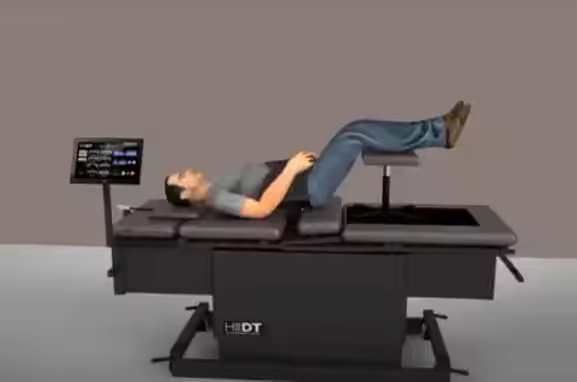
The HillDT system delivers monitored, computer-controlled decompression that continuously checks patient response throughout the session and adjusts the distraction protocol accordingly. That is meaningfully different from a static traction table or a passive stretch belt. The monitoring matters because patient response can change session to session — and a decompression plan that ignores that is just guessing.
Dr. Nick has been practicing for 18 years and specializes in spinal decompression and regenerative medicine at Simply Health Integrated Medical. He used decompression therapy in his own recovery from disc herniations, so he understands the experience from both sides of the table. That informs how he evaluates candidacy, sets expectations, and decides when decompression belongs in a plan versus when chiropractic care, medical referral, or another path makes more sense.
If disc pain, sciatica, or stubborn spine symptoms are limiting your life — or if you have a back surgery recommendation in hand and want a structured second opinion — take the pain-pattern quiz or request a decompression consultation. The next step is finding out whether this option is reasonable for your case, and what to do if it is not.
Research & clinical context
These outside resources are included for education and credibility. They do not replace individualized medical advice, but they help explain why evaluation, fit, safety, and realistic expectations matter.
PMC / Chiropractic & Osteopathy
Useful evidence-limit source supporting careful, evaluation-first language around decompression devices.
View source →
PubMed / Cochrane Database of Systematic Reviews
Evidence review showing why patient selection and realistic expectations matter for traction-style care.
View source →
PubMed / European Journal of Pain
Guideline review supporting conservative, noninvasive evaluation and management pathways.
View source →
Testimonials
A mix of patient testimonials to show a broader range of care experiences.
★★★★★
“I love the staff and the fact that they really know what they’re doing. I’m able to work, and work out with no pain. I’ve been so many places and nothing else worked. I really think you should check these guys out.”
Carlon G
★★★★★
“Simply Health is very professional, and helped me with the pain I’d been dealing with for fifteen years. I highly recommend them!”
Gordon F
★★★★★
“Simply Health was a very positive experience. From the friendly staff to Dr. Deloney himself, who really puts you at ease and talks to you in an understanding language and a caring tone. With their help, I walked out of there feeling fully equipped to accomplish my goals!”
Sharon Wilding
Decompression videos
Learn how decompression works and hear a patient perspective on the care experience.
Frequently asked
Simply Health Integrated Medical at 12977 N Forty Dr, Suite 105, St. Louis, MO 63141 offers HillDT-monitored spinal decompression evaluated by Dr. Nick Hasenfratz, DC. By appointment 24/7. Call (636) 590-4686.
Non-surgical spinal decompression is a controlled, repetitive distraction therapy applied to specific spinal segments with the goal of changing the mechanical and pressure environment around discs and nerves. The HillDT system used at Simply Health Integrated Medical is computer-controlled and continuously monitors patient response — not a static traction belt.
Selected disc bulges, disc herniations, degenerative disc disease, lumbar and cervical radiculopathy, sciatica, facet-irritation patterns, post-laminectomy syndrome, and stubborn neck or low-back pain that has not responded to other conservative options. Candidacy is decided after evaluation — not over the phone.
Dr. Nick Hasenfratz, DC, performs the spinal decompression evaluation. He has been practicing for 18 years, specializes in spinal decompression and regenerative medicine, and has personally used decompression therapy in his own disc herniation recovery.
For the right candidate with a disc-related pattern that has not been fully evaluated outside the surgical lane, HillDT spinal decompression can be a reasonable step to try before assuming spinal fusion or microdiscectomy is the only option. But some patients do need surgery — especially with progressive neurological deficits, severe instability, or red flags. The candidacy evaluation determines which group you are in.
A course of care depends on symptom severity, imaging, and how the patient responds to the first few sessions. Expected milestones are reviewed during the candidacy evaluation rather than committing to a one-size-fits-all session count.
Most patients describe HillDT decompression sessions as comfortable — the system uses controlled, monitored distraction rather than aggressive force. Patient response is checked throughout the session and the protocol is adjusted accordingly. Significant pain during a session would trigger a re-evaluation rather than 'pushing through.'
For sciatica that has a disc-related driver — confirmed by exam findings and often by prior imaging — spinal decompression can be a reasonable option to evaluate. Not all sciatica is disc-driven, which is why the evaluation looks at the pattern before recommending a plan.
Next step
A consultation helps the team understand your goals, health history, and whether this service belongs in your care plan. The goal is fit, clarity, and a practical recommendation — not a generic protocol.